
"Philippine coffee regions"
37 article(s) found

Introduction of coffee countries in the world: an introduction to the development history and characteristics of coffee in different regions of different countries
Coffee production belt: the coffee belt (coffee production zone) ranges from 25 degrees north latitude to 30 degrees south latitude, including many countries in Central, West Africa, the Middle East and South Asia, the Pacific, Latin America and the Caribbean. The reason why coffee cultivation is concentrated in this area is due to the limitation of temperature. Coffee trees are very vulnerable to frost and are not suitable for north or south latitudes.

Guatemala Inchert coffee production area introduction Guatemala coffee brewing how
Professional barista exchange please pay attention to coffee workshop (Weixin Official Accounts cafe_style )[Manor Introduction] Inkert Manor is located in the famous producing area of Guatemala Vivetnanguo Plateau. Coffee has been grown by the Aguirre family since 1900. The name of the manor is taken from the name of a local fruit. Inkert Manor pays special attention to the protection of ecological environment and organic cultivation.

An introduction to the four major producing areas and manors in Guatemala-- Raminita Manor in Miniguo Heights
To really understand the flavor changes and product differences of coffee beans is to understand the production place and growers, different manors with different flavors, or different flavors on different hills of the same manor, and the story behind each coffee bean is what the fragrance wants to know. It can be traced back to which plot of the estate where the beans came from, or which cooperative or which farmer, chasing the flavor of the region. To

What's the difference between Cortado and a little latte? what's the difference between Cortado around the world?
A customer walks into your coffee shop and orders a Cortado. According to your point of view or your position in the world, you can give them a lot of drinks. For some people, Cortado is the ratio of coffee to steamed milk. For others, it's a small piece of white or latte. Some even say it depends on the customer. There are so many questions about what Cortado is.

An introduction to the four major producing areas and manors in Guatemala-- the Incht Manor in Minnan.
To really understand the flavor changes and product differences of coffee beans is to understand the production place and growers, different manors with different flavors, or different flavors on different hills of the same manor, and the story behind each coffee bean is what the fragrance wants to know. It can be traced back to which plot of the estate where the beans came from, or which cooperative or which farmer, chasing the flavor of the region. To

Information on four major coffee producing areas and estates in Guatemala recommendation of Guatemalan coffee beans
Professional coffee knowledge exchange more coffee bean information please follow the coffee workshop (Wechat official account cafe_style) Guatemala Guatemala this country has a lot of volcanoes, the Guatemalan coffee beans produced under the volcanic soil are taste-rich boutique coffee, the average altitude in Guatemala is very high, high altitude means that the environment in which coffee trees grow will have a large temperature difference between day and night.

Nanyang Coffee-the ancestor of Chinese coffee! Chinese people have different feelings in drinking coffee.
When it comes to Chinese coffee, the older generation will think of Nanyang coffee. Last night the code clerk made a cup of coffee for his grandfather at home. He talked a lot about Nanyang coffee while drinking it. "the coffee we used to drink was really fragrant and cool. Although it tasted rough, Nanyang coffee was created by the wisdom of generations of Chinese.

La Minita Flower God, La Tisa Manor, Farahan Plateau, Guatemala
To really understand the flavor changes and product differences of coffee beans is to understand the production place and growers, different manors with different flavors, or different flavors on different hills of the same manor, and the story behind each coffee bean is what the fragrance wants to know. It can be traced back to which plot of the estate where the beans came from, or which cooperative or which farmer, chasing the flavor of the region. To

What are the famous manors in Guatemala? Visit Guatemala producing areas and manors and eight major producing areas
To really understand the flavor changes and product differences of coffee beans is to understand the production place and growers, different manors with different flavors, or different flavors on different hills of the same manor, and the story behind each coffee bean is what the fragrance wants to know. It can be traced back to which plot of the estate where the beans came from, or which cooperative or which farmer, chasing the flavor of the region. To

Why is Taiwan Unification Group willing to withdraw from Shanghai Starbucks? Is it foresight or is it forced by the situation?
Professional barista exchanges please follow the coffee workshop (Wechat official account cafe_style) Taiwan Unification Group announced in late July a stock exchange deal with Starbucks of the United States, selling its 50% stake in Shanghai Starbucks and buying 50% stake in Starbucks in Taiwan. From then on, Starbucks in the United States has 100% control of Shanghai, while Unification has 100% stake in Starbucks in Taiwan.

A great shock! Taiwan media exposed the inside story of Unification Group selling Shanghai Starbucks! It all comes from ambition.
Exchange of professional baristas Please pay attention to the Coffee Workshop (official Wechat account cafe_style) when the golden rooster mother grows up and will eventually be returned to its owner, what preparations will you make before that? In late July, Uni-President announced a "stock swap" deal with Starbucks of the United States, selling its 50% stake in Shanghai Starbucks and buying Taiwan Starbucks.

Boutique Coffee introduction to 53 Coffee producing areas around the World
forty-four. In 1715, the first coffee trees (about 40) were transported from the Yemeni port of Moka to La Runion, but unfortunately only two survived. By 1719, coffee plantations had flourished and the first beans were sold. Over the next few years, the government took a hard measure: the islanders, black and white, had to plant 100 coffee trees a year.

Introduction of Coffee from 53 Coffee producers in the World (5)
forty-one. Coffee cultivation in Zimbabwe (Zimbabwe) began relatively recently, in the 1960s, when farmers in southern Africa set up coffee plantations. Coffee cultivation in Zimbabwe is mainly concentrated in the eastern highlands near Mozambique, mainly by the Chimanimani mountains and northward Nyanga (Ny).

World Map of Coffee beans-- introduction of 53 coffee producing areas in the world
twenty-one. Venezuela oil was once considered the main export of Venezuela (Venezuela). Although coffee trees were introduced from Martinique in 1730 and Venezuela, coffee production was almost abandoned at the height of the oil industry. Recently, coffee plantations have begun to recover, with original Tipica and bourbon coffee trees and new plantations
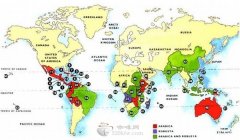
Introduction of Coffee from 53 Coffee producing areas in the World
one. Costa Rican coffee has full grains, ideal acidity and unique strong aroma. Tarrazu of Costa Rica is one of the major coffee producing areas in the world. Costa Rica, with its fertile volcanic soil and good drainage, is the first country in Central America to grow coffee and bananas for commercial value. Coffee and fragrance
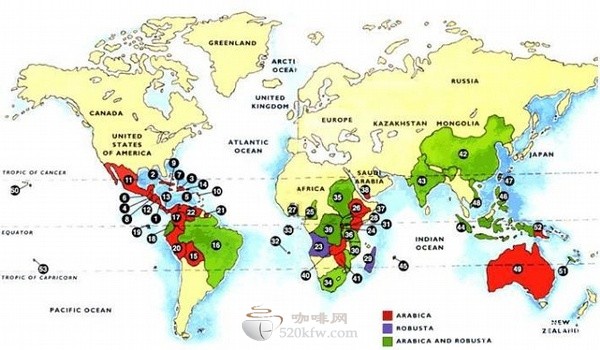
Coffee beans from 53 producing areas-enough to make you memorable
one. Costa Rican coffee has full grains, ideal acidity and unique strong aroma. Tarrazu of Costa Rica is one of the major coffee producing areas in the world. Costa Rica, with its fertile volcanic soil and good drainage, is the first country in Central America to grow coffee and bananas for commercial value. Coffee and fragrance
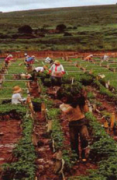
Have a comprehensive understanding of coffee
Legend of Coffee the person who first discovered coffee: a shepherd in Ethiopia, in the fifth and sixth centuries AD. It is said that Niankadi, a shepherd with talent as a poet, herded sheep on the mountain paths of the Ethiopian plateau every day. He liked to drive the sheep home with a shrill flute, but one day the flute sounded again and there was no sign of the sheep. He looked everywhere. Find sheep